Detailed Information on Closed-Type Busway
Recommended by Darui Electric
The busway is characterized by series matching, commercial production, small volume, large capacity, short design and construction cycle, easy assembly and disassembly, non-combustibility, safety and reliability, and long service life. The busway products are suitable for three-phase four-wire and three-phase five-wire power supply and distribution system projects with AC 50Hz, rated voltage 380V, and rated current 250A-6300A.
Edit
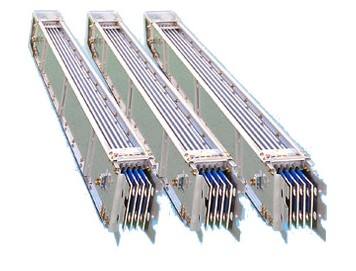
A closed-type busway (referred to as busway) is a busbar system composed of a metal plate (steel plate or aluminum plate) as the protective shell, conductive bars, insulating materials, and related accessories. It can be made into a plug-in closed busbar with plug-in junction boxes at intervals, or a feeder-type closed busbar without junction boxes in the middle. In the power supply system of high-rise buildings, power and lighting circuits are often set separately. The busway, as the main power supply trunk, is installed vertically along the wall in the electrical shaft, either in one run or multiple runs. According to usage, a busway run generally consists of a starting busway, straight-through busway (with or without plug-in holes), L-type vertical (horizontal) elbow busbar, Z-type vertical (horizontal) offset busbar, T-type vertical (horizontal) tee busbar, X-type vertical (horizontal) cross busbar, variable-capacity busway, expansion busway, terminal cap, terminal junction box, plug-in box, related accessories, and fastening devices. According to insulation methods, busways can be divided into three types: air-type plug-in busway, dense insulation plug-in busway, and high-strength plug-in busway. According to structure and usage, they are divided into dense insulation, air insulation, air additional insulation, fire-resistant, resin insulation, and sliding contact busways; according to shell material, they are divided into steel shell, aluminum alloy shell, and steel-aluminum mixed shell busways.
Edit
According to usage, a busway generally consists of a starting busway, straight-through busway (with or without plug-in holes), L-type vertical (horizontal) elbow busbar, Z-type vertical (horizontal) offset busbar, T-type vertical (horizontal) tee busbar, X-type vertical (horizontal) cross busbar, variable-capacity busway, expansion busway, terminal cap, terminal junction box, plug-in box, related accessories, and fastening devices.
According to insulation methods, they can be divided into three types: air-type plug-in busway, dense insulation plug-in busway, and high-strength plug-in busway.
Air-type plug-in busway (BMC). Since the joints between busbars are connected by soft copper sheets, in humid southern weather, oxidation easily occurs between joints, causing poor contact between joints and busbars, making the contacts prone to heating. Therefore, it is rarely used in the south. Moreover, the joints take up too much space, the horizontal busbar sections are not uniform in size, and the appearance is not aesthetically pleasing.
Dense insulation plug-in busway (CMC). Its moisture-proof and heat dissipation effects are relatively poor. In terms of moisture resistance, the busbar is prone to moisture and water seepage during construction, causing a decrease in phase-to-phase insulation resistance. The heat dissipation of the busbar mainly relies on the shell. Due to the compact arrangement between wires, the heat of L2 and L3 phases dissipates slowly, resulting in a high temperature rise of the busway. The dense insulation plug-in busway is limited by the shell plate material and can only produce horizontal sections no longer than 3m. Due to the small air gap between phases, when large currents pass through, strong electrodynamic forces are generated, causing the magnetic oscillation frequency to form a superimposed state, resulting in excessive noise.
High-strength closed-type busway (CFW). Its manufacturing process is not limited by the plate material. The shell is made in a corrugated form, increasing the mechanical strength of the busbar, and the horizontal section can be produced up to 13m long. Since the shell is corrugated, the grooves are designed to separate and fix the busbars, with an 18mm gap between busbars, allowing good ventilation between lines, significantly improving the moisture-proof and heat dissipation functions, making it more suitable for southern climates. Due to the gaps between lines, the temperature rise of the conductors decreases, thereby increasing overload capacity and reducing magnetic oscillation noise. However, its stray current and inductance are much larger than those of dense insulation busways. Therefore, when comparing the same specifications, its conductive bar cross-section must be larger than that of dense insulation plug-in busways.
Note: The above information and technical parameters are compiled and released by Yangzhou Darui Electric Co., Ltd.