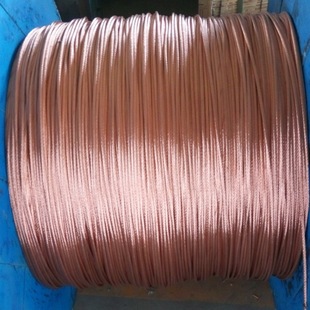
Copper Contact Wire
Darui Electric recommends
Contact wire, also known as trolley wire, is an important component of the overhead contact system, generally made in a cylindrical shape with grooves on both sides. The grooves are designed to facilitate the installation of clamps and to suspend and fix the contact wire without affecting the sliding current collection of the pantograph. The lower part of the contact wire, which contacts the pantograph slider, is arc-shaped and is called the working surface of the contact wire. The contact wire directly transmits current to the electric locomotive through sliding friction with the pantograph slider, and its performance directly affects the current collection quality of the electric locomotive and the
locomotive's safe operation. The contact wire is the most severely working environment among all power supply conductors; during normal operation, it must withstand impact, vibration, temperature changes, environmental corrosion, wear, electric spark erosion, and extremely high working tension. Therefore, its performance directly affects the safe operation of high-speed trains.
The consumption of contact wire increases with the continuous construction and renovation of China's railways, subways, and light rail transit, as well as the growth of total line mileage. At the same time, achieving comprehensive speed increases has become a set policy of the Ministry of Railways. Copper-silver contact wire, which is suitable for use at medium and quasi-high speeds and has high
tensile strength (breaking force) and electrical conductivity almost identical to copper, has become one of the preferred wire types. It can be expected that in the near future, the demand for copper alloy contact wires, especially copper-silver contact wires, will exceed that of copper contact wires. Large quantities of domestically produced and a considerable amount of imported copper-silver contact wires are continuously being produced, installed, and put into operation, creating opportunities for the development and application of contact wires in China, as well as for the development of new materials, new products, new processes, and new equipment, and for promoting localization.
Process and Characteristics
Strength Distribution
The uniformity of the alloying element silver in copper directly affects the uniformity of the product's tensile strength (breaking force). The melting point of silver is relatively close to that of copper, and it disperses well in copper during melting, making copper-silver alloy one of the easier copper alloys to produce. There are two methods for adding silver: direct addition and master alloy addition. Either method is acceptable as long as it achieves uniform composition and low burning loss; if the former can achieve this, it represents a higher level of technology.
Copper-silver contact wire is produced by two methods: continuous casting and continuous casting-rolling. The uniformity of composition depends on melting and casting, especially the type of furnace used for melting copper. In China, the furnace type used for producing rods by the upward continuous casting method is typically a core-type induction furnace with a channel, where the furnace channel serves as the secondary coil, providing stirring action to the molten copper, thus ensuring composition uniformity. In contrast, the continuous casting-rolling method generally does not use this type of furnace. From the perspective of ensuring composition uniformity, the upward continuous casting method is superior to the continuous casting-rolling method for rod production.
Wire Drawing and Stringing
The straightness of the contact wire directly affects the separation between the pantograph and the contact wire after stringing and operation. Excessive separation can cause arcing and erosion. Practice has shown that straightness is directly related to the straightening force after factory wire drawing, on-site stringing operations, and straightening during stringing, and is not related to the manufacturing method, grain size, deformation non-uniformity, or uneven internal stress distribution. In fact, cold-drawn double-groove contact wires have non-uniform deformation, hardness distribution, grain size and distribution, and internal stress distribution across the entire length and cross-section, especially severe at the two grooves. These factors cause unevenness in the entire batch, on each spool, and along the entire line after stringing.
Internal Defects
The brittle fracture of contact wire is not directly related to the manufacturing method. Brittle fracture of contact wire is generally directly related to severe internal defects such as inclusions, slag, and porosity, and may even be related to hydrogen embrittlement. These defects mostly occur during melting and casting processes, but hydrogen embrittlement can be traced back to the entire process from electrolytic copper to melting, casting, and hot rolling. Therefore, regardless of the manufacturing method, having stable production processes and strict operation is key to minimizing sudden brittle fractures, and the inspection of internal defects in the produced products should comply with China's fracture inspection methods.
In the production process, using continuous non-destructive testing to intercept severe internal defects is one way to prevent hazards, but there are often missed detections or difficulties in normal operation due to overly sensitive instruments. Brittle fractures have occurred in contact wires produced by different manufacturing methods both domestically and internationally, which sufficiently indicates that missed detections are inevitable. The reason is related to the preparation of reference samples for testing; using only eddy current testing (which detects surface defects) cannot find deep-level defects, and ultrasonic testing must also be applied. As for where in the process testing should be conducted, further research is necessary, and instruments and methods that are suitable for online normal operation and can effectively detect defects should be developed.
Note: The above information and technical parameters are compiled and published by Yangzhou Darui Electric Co., Ltd.