DARUI Electric recommends
Mobile equipment needs to constantly change positions due to movement, and at each different position, it must be able to obtain power supply at any time; otherwise, it cannot continue moving. This is where busbars come into play. Several conductors are laid parallel along the track of the mobile equipment and connected to the power supply. On the moving equipment, a current collector is installed that can draw power from the conductors. Thus, when the equipment moves, the current collector moves synchronously with it and continuously obtains power from the conductors to supply the equipment, allowing it to keep moving. The device composed of these conductors and the current collector is called a busbar.
The power supply busbar device consists of three main components: the sheath, the conductor, and the current collector, along with some auxiliary components.
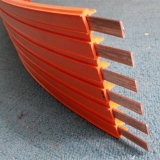
1. Sheath: It is a semi-enclosed tubular component and the main part of the busbar. Its interior can be embedded with 3-16 bare guide rails as power supply conductors as needed, with each rail insulated from the others to ensure safety of power supply. It effectively prevents electric shock accidents for maintenance personnel during live maintenance. Each length of the conduit produced by the manufacturer varies and can be connected to any required length. Ordinary conduits are made in straight shapes, but can also be made into arc shapes or other special shapes according to specific requirements.
2. Conductor: The main material is copper, with common cross-sectional areas of 10 mm², 16 mm², and 25 mm².
3. Current collector: It is a set of brush housings that run inside the conduit, driven by a fork (or traction chain, etc.) installed on the electrical mechanism (such as a crane, trolley, or electric hoist), allowing it to move synchronously with the mechanism. It transmits electrical energy from the guide rails and brushes to the motor or other control elements. The number of poles of the current collector brushes ranges from 3 to 16, corresponding to the number of guide rails in the conduit.
(2) Product Features
1. Safety: The housing of the power supply busbar is made of engineering plastic with high insulation performance. The protection rating of the housing can reach IP13 or IP55 as needed, protecting against rain, snow, ice, and contact with hanging objects. The product withstands various environmental conditions. It has good insulation performance and poses no harm to maintenance personnel touching the outside of the conduit.
2. Reliability: The power transmission guide rails have excellent conductivity, dissipate heat quickly, have high current density, low impedance, and low line loss. The brushes are made of metal graphite material with high conductivity and high wear resistance. The current collector moves flexibly with good directional performance, effectively controlling contact arcs and series arcs.
3. Economy: The power supply busbar device has a simple structure, using copper bars with high current density, low resistivity, and low voltage loss as the main conductive body. It can save about 6% of electricity, achieving the substitution of plastic for steel and copper. The design is novel, requiring no additional insulation structure or compensation wires. It is installed on the same side as the crane control room, saving installation materials and costs. Its overall cost is roughly the same as that of bare steel busbars.
4. Convenience: The power supply busbar device integrates multiple levels of busbars into a single conduit, making assembly simple. Its fixing brackets, connecting clamps, and suspension devices are supplied as universal parts, making installation, disassembly, adjustment, and maintenance very convenient.

Note: The above information and technical parameters are compiled and released by Yangzhou DARUI Electric Co., Ltd.