Electric Self-Propelled Trolley Conveyor System
Darui Electric Recommends
(I) DZ Type Monorail Trolley Overhead Conveyor (Electric Monorail Self-Propelled Trolley)
The electric monorail self-propelled trolley is a new type of fully automatic material storage and transportation system that resembles an electric hoist and an accumulating overhead conveyor in appearance, and functionally lies between the two.
1. Functional Features:
(1) Distributed Drive: Power is changed from centralized drive to separate drive for each conveying unit (trolley);
(2) Motion Control: The control system can control each material conveying unit in real time. The conveying trolley can perform various actions such as lifting, traveling, and swinging at workstations as needed;
(3) Accumulation Method: The running trolley is controlled by the electrical control system to stop at work positions and automatically accumulate and stop when encountering obstacles during operation.
(4) Three-Dimensional Network: Material routes are combined with tracks, transfer switches, turntables, and elevators to form a three-dimensional material conveying network;
(5) Modular Assembly: The track, switches, and other functional systems of the self-propelled trolley are mature components, and the control methods are also mature, allowing arbitrary combination, with short manufacturing, construction, and delivery cycles;
2. Applicable Scope:
(1) Multiple Control Modes: Centralized control, decentralized control, or distributed control can be adopted, and the running trolleys work reliably according to preset programs. Setting workstation addresses, fixed-point work, and fixed addressing are suitable for painting production lines and assembly lines;
(2) Random Logistics Supply System: Workstations make real-time material conveying requests, and the system randomly writes the address code of the requesting workstation for the running trolley, which then goes directly to the material-requesting station and returns with supplies. The running trolley has random address recognition and writing functions. The workstation's material request can be manual or automatically triggered by the central control room monitoring the material status of each workstation, and it can be networked with the management computer system. It is suitable for ***, internal combustion engine components, and product warehousing and conveying lines.
(3) Sorting System: The running trolley carries different address codes according to the different goods it carries, and ground reading stations are set up to determine the trolley's conveying direction and destination. It is suitable for postal sorting lines, internal combustion engine testing lines, quality inspection lines, and textile system conveying lines.
1. Main Functional Components:
(1) Travel Track: For conveying systems with a load of 2t or less, aluminum alloy rails are often used as travel tracks, making the laying of conveying lines more ideal and ***. Our company uses high-strength aluminum alloy, which is surface-oxidized and has good strength and wear resistance. The customized double-T structure ensures reliable connection with steel auxiliary beams and sliding conductive rails. Our company has introduced technology from French Vallet Company to design a dedicated sliding contact line for the electric self-propelled trolley system, which has good reliability and is easy to install. For conveying systems over 2t, H-beam steel is recommended as the travel track.
(2) Sliding Conductive Rail: The sliding type plays an important role in supplying three-phase four-wire power and transmitting control signals in the electric self-propelled trolley system. The quality of the product directly affects the reliability of the system. Our subsidiary, Wuxi Huadao Electrical Appliance Factory, is a *** manufacturer of sliding conductive devices, and the *** standard for sliding mobile power supply devices was drafted by our company. The self-propelled trolley adopts a double carbon brush structure for more reliable signal transmission;
(3) Transfer Switches, Turntables, and Elevators: To form a three-dimensional conveying network, transfer switches, turntables, elevators, and other system components are installed at appropriate positions on the conveying line, allowing the running trolley to transfer from one travel track to another, meeting the functions of material diversion, merging, and transfer;
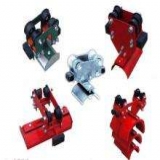
(4) Running Trolley: The running trolley is divided into two categories: ordinary type and intelligent type. According to travel speed, it can be classified into fixed speed and variable frequency speed regulation types. The running trolley is composed of two to multiple trolley groups depending on the material. Each running trolley has the function of automatically stopping when encountering obstacles and automatically moving when obstacles disappear. The running trolley can be controlled by its own control pendant or ground button station;
(5) Spreader: The spreader connecting materials has two modes: manual and automatic, which can be selected for users according to different process requirements. Of course, users can design their own and connect it to the hoist hook of the running trolley.
(6) Electrical Control System: The electrical control system consists of programmable logic controllers, encoding devices, address recognition devices, position sensors, and other actuators. Equipped with different control programs, it processes various action requirements of the functional components of the conveying system in real time and completes the process actions of the entire conveying system. Physically, it is generally divided into the main control cabinet, button stations at each workstation, trolley electrical control cabinets, and alarm display devices; for large and complex systems, there may be a *** control room, programmable logic controller network, and other functional components.
With the rapid development of e-commerce, the continuous increase in transportation orders has brought new challenges to modern logistics systems. The integration of materials and goods flow has driven the automated logistics system into a high-demand level.