C-type Cable Trolley Rail Guide Product Introduction
Darui Electric recommends
This product is mainly used in the cigarette production line designed by CMOAS Company of Italy for China. It is a key component provided by CMOAS. On tobacco production equipment such as the DM-type distribution and conveying device, MCA series silo-type feeder, SAM series leaf blending cabinet, SAD series tobacco storage cabinet, and FIFQ series stacking-type leaf storage cabinet designed by CMOAS, it is the most ideal product for power supply of mobile crane motors and electrical appliances, as well as signal transmission of electronic devices. It is an indispensable supporting product for various crane manufacturers, can be used interchangeably with imported products, and can also serve as a spare part for equipment. It is widely applicable to power transmission and distribution systems of all mobile cranes in railway crossings, ports, freight yards, cigarette manufacturing, and other places.
II. C-type Cable Trolley Rail Guide Structural Features and Working Principle
1. This set of products consists of three main parts: flat cable, four-wheel trolley for carrying cable, and guide rail. The flat cable is made of non-flame-propagating material, suitable for indoor and outdoor use and places with oil contamination, and has certain weather resistance. Compared with round cable, it has advantages such as smaller bending radius and longer service life.
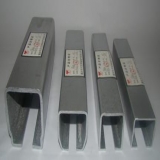
The rail is formed by one-time cold drawing of cold-rolled steel plate to ensure the accuracy of the rail cross-section dimensions, replacing angle steel and other conductive methods that are unsafe, heavy, and prone to short circuits caused by dust accumulation indoors and icing outdoors, which affect usage. It also has domestic unique features. The rail unit length is 4~6m, connected by coupler connectors, and can be extended to any length as needed.
2. Working principle: The starting end of the flat cable (connected to the on-site junction box) is fixed to the starting end fixer of the guide rail. Then, according to the space allowed for operation on site, it is sequentially fixed to the four-wheel trolleys carrying the cable at appropriate intervals (1-2.5mm). The end of the cable (connected to the power supply) is fixed to the last trolley (traction trolley). Through the reciprocating movement of the pulling trolley driven by the spring puller on the trolley, and through the dragging effect of the cable (if the length exceeds 20m, the original traction rope should be considered to protect the cable from tension), all trolleys are driven to slide freely at any speed in the rail. The guide rail is easy to install, requires no debugging, and has the advantages of contactless power supply, making it safe and reliable.
3. Complete set product structure
1) Rail
The rail is the carrier of the cable-carrying trolley. It has straight sections and arc sections with radius greater than 500mm. The straight section unit length is 4 meters (or 6 meters), and it can be extended by connecting with couplers.
2) Leading trolley: The leading trolley provides the traction for the cable-carrying trolley. It is moved by other moving parts to drive the movement of the trolleys behind it. Four fully sealed rolling bearings serve as the running wheels, making sliding very flexible and suitable for dusty environments.
3) Intermediate trolley: The running wheels of the intermediate cable-carrying trolley are also fully sealed bearings. The part that clamps the cable uses an arc-shaped soft rubber pad layer to prevent damage to the cable. Both the leading trolley and intermediate cable-carrying trolleys are equipped with anti-collision buffers to ensure that the trolleys are not impacted during starting and stopping.
4) Coupling connector: Formed by rolling cold-rolled plates. Through the locking action of bolts, two rails are connected together, allowing unlimited extension of the guide rail.
5) Hanger: Suspends the rail, with bolt locking to prevent the rail from moving. The oval mounting holes allow for correction of the rail linearity.
6) Starting end: The starting section of the guide rail, where the cable is fixed at the start. One end enters the cable-carrying trolley, and the other end enters the power supply box.
7) End: Installed at one end of the guide rail to prevent the leading trolley from sliding off the rail.
8) Puller fork: Drives the trolley to move back and forth.
III. C-type Cable Trolley Rail Guide Main Technical Data:
1. Rated voltage: below AC750V.
2. Material and cross-sectional area of each core conductor: rubber-sheathed flat flexible cable, multi-strand copper core wire 1.5-50mm2
3. Ambient temperature: -20°C~+90°C
4. Running speed of four-wheel trolley: <90m/min
5. Working life of four-wheel trolley: <3200h
6. Maximum allowable static load: 150kg
IV. C-type Cable Trolley Rail Guide Ordering Information
1. Rail length (m)
Determined by the user based on the actual running distance of the crane, plus the distance for storing the four-wheel trolleys.
2. Cable length (m)
Actual running length + distance for storing trolleys + necessary length to reach the electrical equipment and junction box.
3. Number of four-wheel trolleys
Generally 1/2 of the total rail length. Users can increase or decrease the number of four-wheel trolleys according to the allowable cable sag space.
4. Number of coupling connectors:
Based on the total rail length, accessories are needed for rails exceeding 4m.
V.