Crane Ф6-Ф30mm Copper Sliding Contact Wire DARUI
Darui Electric recommends for you
I. Contact wire (also known as electric locomotive overhead wire, gantry crane trolley wire):
1. Trolley wire copper contact wire (also known as double-groove copper wire, bare copper wire): CT series (CT85, CT110, CT120, CT150, CT185, CT200, CT220, CT250). Made of oxygen-free copper, featuring high conductivity and high strength.
2. Copper alloy contact wire: Copper-silver alloy CTAH series (CTAH85, CTAH110, CTAH120, CTAH150, CTAH185),
Copper-magnesium alloy CTMH series (CTMH110, CTMH120, CTMH150);
3. Enclosed steel-aluminum composite trolley wire: GLCN series (GLCN195, GLCN250); 4. Exposed steel-aluminum composite trolley wire: CGLW series (CGLW100, CGLW173, CGLW215);
5. Steel-core aluminum alloy composite trolley wire: CGLHD series (CGLHD195, CGLHD260, CGLHJ260);
6. Aluminum alloy trolley wire: CLHA series (CLHA 130, CLHA 170, CLHA 200);
7. Trolley copper sliding wire: Ф6mm------Ф30mm;
8. Double-groove copper sliding wire: 35mm2------185mm;
9. Safety sliding contact wire
II. Suspension hardware (also known as suspension tightener, suspension clamp):
1. Current collector assembly (pantograph collector), collector head, carbon slider, copper connection rod, trolley wire copper-aluminum transition (SLT-1, SLT-2), disc-type copper feeder clamp;
2. Chain-type suspension assembly, rigid suspension assembly, armored suspension clamp, curve suspension clamp (-001), phenolic suspension clamp (AK-1);
3. Suspension porcelain insulator (CD-1, -1), rigid porcelain insulator (-02), trolley wire pin-type porcelain insulator (P-6-10-15), chain suspension porcelain insulator, rigid clamp plate (120mm, 150mm, 300mm), wire puller (XK-1), suspension plate;
4. Single wire clamp (DXK-1, DXT-1), double wire clamp (DXK-2, BXT-2), parallel connection clamp (BJK-1, BJK-2, BJK-1, BJT-2, BJKT-1), ring clamp (KH-1), aluminum feeder clamp (KDL-1), copper feeder clamp (KDT-1), jumper clamp (DA-1), terminal clamp (ZD-1-2-3), dropper clamp (DJ-1), crimping tube single wire clamp, crimping plate single wire clamp, chain suspension clamp, steel rope clip (12mm-15mm);
5. Section switch (HHP1-200, HHP1-200-600), trolley wire section insulator (F-1, F-2), insulator (J-1, J-2, J-4.5), insulated joint plate, terminal adjustment hook (TJ-12, TJ-16), horizontal suspension hook, single catenary arm, double catenary arm.
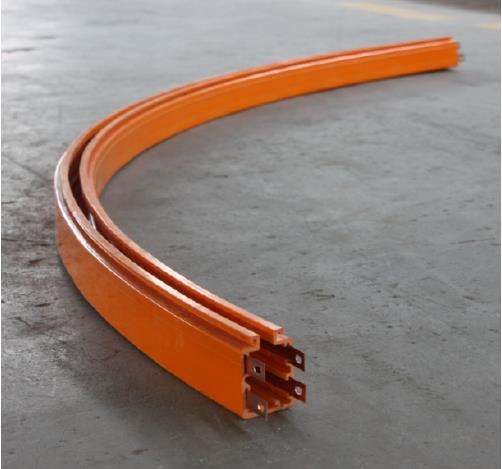
Crane Ф6-Ф30mm Copper Sliding Contact Wire
Product Details
Crane Bare Copper Rod Sliding Wire
In the operation of overhead contact lines, to ensure that the contact wire does not break under a certain tension, it is required to conduct a wear measurement of the contact wire at least once a year. When the wear of the overhead contact line contact wire reaches a certain level, reinforcement or replacement should be carried out. If the average wear of the contact wire in the entire anchor section exceeds 25% of the cross-sectional area of that type of contact wire, it should be completely replaced. If the average wear does not reach 25% but local wear exceeds 30%, local reinforcement can be carried out. When local wear reaches 40%, replacement should be performed.
The focus of wear measurement should be on positioning points, electrical connections, wire joints, center anchor points, phase breaks, and sectioning joints. Use a vernier caliper to measure the remaining height of the contact wire, and then refer to the wear conversion table for that model of contact wire to determine the wear area (the cross-sectional area worn away) at that location.
Contact wire stagger value and pull-out value
The positioner fixes the contact wire in the correct position, which is called positioning. The point where the positioner clamp fixes the contact wire is called the positioning point. The horizontal distance from the positioning point to the centerline of the pantograph's running trajectory is called the stagger value on straight sections and the pull-out value on curved sections. The function of the stagger value and pull-out value is to ensure uniform wear of the pantograph slide plate and to prevent accidents such as pantograph detachment and scraping.
On straight sections, the center of the pantograph coincides with the centerline of the track. The stagger value of the contact wire is symmetrically arranged along the track centerline, with a standard of ±300mm. After speed increase, it is between 200 and 250mm; the pull-out value is between 350 and 450mm.
On curved sections, the pull-out value is related to the radius of the curve.
Insulators used in overhead contact lines
Insulators are used to suspend and maintain electrical insulation from grounded objects.
The insulators used on overhead contact lines are generally porcelain, made by firing a mixture of clay, quartz, and feldspar, with a smooth glaze on the surface.
Crane Bare Copper Rod Sliding Wire The insulators used on overhead contact lines are divided into suspension-type and post-type insulators according to structure; according to the surface length of the insulator (i.e., leakage distance), they can be divided into ordinary type and anti-pollution type. In recent years, toughened glass suspension insulators have been widely promoted. These insulators have high mechanical strength (2 to 3 times that of porcelain insulators), good electrical performance (average breakdown strength under impulse waves is 3.5 times that of porcelain insulators), long service life, resistance to aging, easy maintenance, and good self-cleaning properties. Their notable feature is "self-breakage at zero value," meaning that when the insulator loses its insulating performance or is mechanically overloaded, the shed will automatically crack and fall off, making it easy to detect and replace in a timely manner. In recent years, China has developed and used e?1 type epoxy resin insulators, fluoroplastic and silicone rubber disc-post insulators, and semi-x?5 type and semi-tx-25 type semiconductor glaze insulators. Semiconductor glaze insulators significantly extend the cleaning cycle of insulators, improve the reliability of power supply, and have shown good trial results, but they have disadvantages such as relatively large leakage current. A more ideal new type of insulator is the composite polymer insulator. This type of insulator is made by combining two polymer materials, one to improve mechanical strength and the other to improve insulating performance, so that the composite polymer insulator can meet the requirements of high mechanical strength, good insulating performance, impact resistance, arc resistance, and light weight. This is also the future development direction of insulators
Note: The above information and technical parameters are compiled and released by Yangzhou Darui Electric Co., Ltd.