Darui Electric recommends
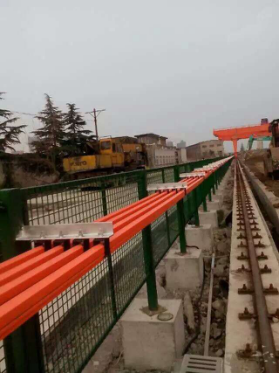
Single-pole Curved Arc Trolley Wire is made by bending H-type aluminum or copper profiles and their ABS insulating sheaths into the curves required for equipment movement, allowing the equipment to turn or run in an arc. This product requires extremely high craftsmanship and accurate on-site measurement; otherwise, it may cause excessive swinging of the current collector, unstable power transmission, discontinuous equipment movement, or even damage and deformation of the current collector.
Single-pole Curved Arc Trolley Wire, also known as arc trolley wire (curved track) or curved track trolley wire, includes HXPnR-H, HXPnR-L8, and HXPnR-H thickened series. The single-pole combined three-wire, four-wire, and five-wire trolley wires are composed of H-type aluminum alloy main rail with pressed V-type stainless steel sliding strip, PVC insulating shell, external current collector, and suspension and fixing components. This product is widely used in occasions with high current, high frequency of use, fast running speed, and poor environments due to its novel design, reasonable structure, easy maintenance, anti-corrosion and dust-proof performance, and safe use.
Features of Single-pole Curved Arc Trolley Wire
The H-type trolley wire is manufactured as single-pole and can be arbitrarily combined into multi-pole. It uses standard brackets for combined suspension, making installation easy. The creepage distance between poles is large, so it can be used even in high humidity environments. The current collector has good heat dissipation and high running speed. The single-pole current-carrying capacity is large, meeting the needs of mobile power-receiving equipment with high current. The standard length of a single trolley wire is 6 meters.
Single-pole curved arc trolley wire is made by bending H-type aluminum or copper profiles and their ABS insulating sheaths into the curves required for equipment movement, allowing the equipment to turn or run in an arc. This product requires extremely high craftsmanship and accurate on-site measurement; otherwise, it may cause excessive swinging of the current collector, unstable power transmission, discontinuous equipment movement, or even damage and deformation of the current collector.
Note: The above information and technical parameters are compiled and released by Yangzhou Darui Electric Co., Ltd.