Darui Electric recommends for you
For environments with severely corrosive gases, it is also necessary to check the corrosion of brackets, suspension clamps, and tractors; and take timely measures, applying anti-rust materials.
If construction is carried out at the site where the sliding contact line is used, do not impact or collide with the transmission conduit, and never place heavy objects on it. Prevent deformation and cracking of the transmission conduit, which could affect use and cause safety accidents. After construction, immediately remove construction debris from the transmission conduit.
During normal maintenance, personnel are not allowed to step on the transmission conduit or its brackets to prevent damaging the flatness of the entire line and causing accidents.
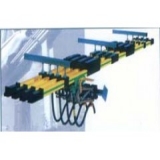
HXPnR-H type protective safety sliding contact line, its conductive main body is an aluminum profile with an "H" cross-section, hence it is also called"H" type energy-saving sliding line device. Energy saving is relative to sliding contact lines mainly made of angle steel, as the loss of electrical energy during transmission is greatly reduced. The resistivity of aluminum is much lower than that of steel, and its specific gravity is small. Rolling aluminum into an "H" shape ensures a certain conductive cross-sectional area while improving overall rigidity and strength. However, the surface hardness of aluminum is low and it is not wear-resistant. To make the aluminum base material practical as a conductive sliding contact line, the "H" shaped beam is made into an arched top, and wear-resistant stainless steel profiles are embedded here according to specified process procedures. This "H" shaped stainless steel profile serves as the friction and current transmission surface for the conductive blocks in the current collector. Its embedding process ensures a tight combination of stainless steel and aluminum profile, so that the current introduced into the aluminum profile passes through the stainless steel body, and the conductive blocks in the current collector in contact with it transmit the current through friction contact, ensuring continuous current during the operation of lifting machinery.
Along the longitudinal direction of the sliding line, the conductive sliding line is entirely protected by ABS plastic, except for the lower opening where it contacts the current collector. Therefore, after installation, there is no exposed conductive part of the contact line, which brings great convenience to installation and maintenance. At the same time, the overall plastic shell protection (except for the opening) prevents dust accumulation and provides protection against rain, dew, ice, and snow. The connection between rails is made by a dedicated rail connector that allows both the rail and the plastic shell to extend into it, and the connection ends are also safe and reliable.
When considering the power supply points for the safety sliding contact line, the total number and total capacity of electrical equipment on the same span, the duty cycle, and the voltage drop over the entire line length, as well as the environment, should be taken into account (voltage drop can be calculated based on the data in the previous rail parameter table). The following power supply methods are generally provided for user reference:①Single-end power supply;②Middle power supply;③Both ends power supply;④Power supply at 1/6 from both ends;⑤Three-point power supply at 1/10 from both ends and the middle, etc.
Installation Instructions
Before installing the sliding contact line, first fix the angle steel brackets according to the installation form selected by the user and the suspension spacing of the sliding contact line. At the installation site, slide the required suspension seats onto each 6-meter section of the sliding contact line, and one joint protective sleeve at each end. Also install one aluminum joint at one end. When installing the aluminum joint, pay attention to only insert the aluminum rail into 1/2 of the joint....