Darui Electric recommends
1. Anti-corrosion treatment should be applied.
2. Continuous welding should be used.
3. Installation should be firm, and mounting hole positions should be accurate.
II. Bracket Spacing
For single-line "H" type below 300A: ≤1.5M; above 400A: ≤3M.
For multi-line seamless busbar type: 1.0-1.5M; conduit type: 1.0-1.5M; cable trolley type: 1.0-2.0M; for arc segments, bracket spacing should be <1.0M based on site conditions.
III. Suspension Components
Position should be correct, installation firm, and quantity should meet requirements.
IV. Busbar Main Body
1. The gap between the protective shell and the conductor should be ≤2mm.
2. Straightness: The allowable deviation from the track center height should be <±15mm.
3. Straightness: The allowable longitudinal deviation from the track center should be <±15mm.
4. Twist: <15mm/10m.
V. Expanders
1. Quantity should comply with regulations.
2. The gap distance should accommodate the theoretical expansion caused by the maximum temperature difference at the installation site.
VI. Current Collectors
1. The square steel bracket should be welded firmly, and the centerline should be perpendicular to the busbar with an allowable deviation of ±3mm.
2. The dimensions of the square steel bracket and the busbar should ensure that the movable arm of the current collector is parallel to the busbar main body, with an allowable deviation of ±3mm.
3. The current collector should slide smoothly on the busbar plane, meeting the specified pressure.
VII. Fasteners
The torque of the fastening nuts should comply with the manufacturer's recommended values. Recommended values: M10-28NM, M8-12NM, M6-6.5NM
VIII. Power Inlet
The inlet end should be secure and should not bear tension.
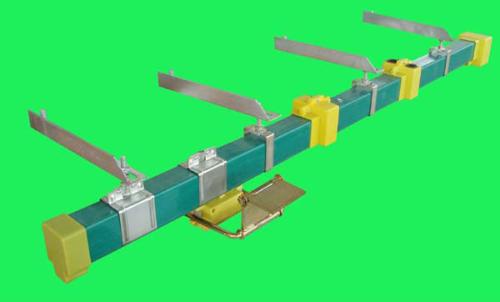
The first is single-pole safety busbar, the second is multi-pole safety busbar, and the third is single-pole steel body busbar. They are collectively referred to as safety busbars. Of course, there are also some special models of busbars, such as seamless busbars, etc.
Single-pole safety busbar is suitable for the power supply system of most mobile equipment. Its simple material, easy installation, easy maintenance and repair, and low price make it one of the first choices for many customers when considering safety busbar specifications. Single-pole busbars are suitable for mobile equipment with currents between 150A and 2500A.
The material of multi-pole safety busbar is copper bar. Its conductivity and energy-saving performance are significantly improved compared to single-pole safety busbars, but the cost also increases significantly. Moreover, due to the different structure, its current carrying capacity is far lower than that of single-pole busbars. It is generally used on small-power mobile equipment, with a current range of 50A to 300A.
Steel body busbars are mainly used in special environments such as high temperature, high corrosion, and high humidity. They can operate in all environments, but due to their high cost, they are mostly selected only in these special occasions.